
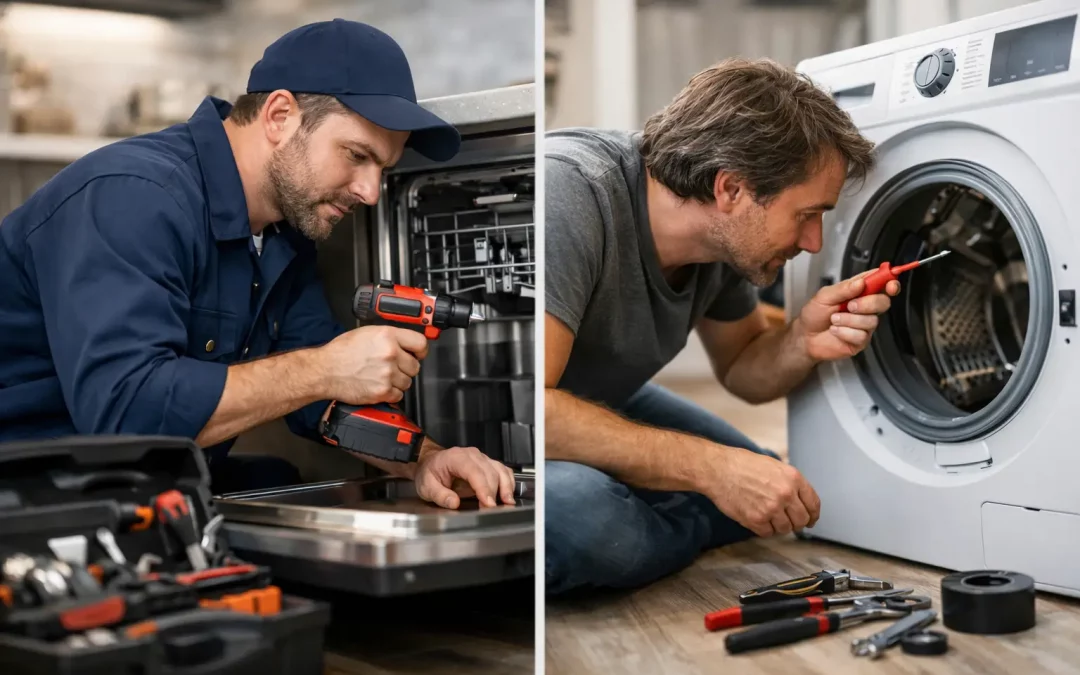
A refrigerator that is warming up or a washer that will not drain creates a quick decision: try to fix it yourself, or call for help. Professional versus DIY appliance repair is not just about saving a service-call fee. It is about safety, the real cause of the problem, the cost of a wrong repair, and how long your household can function without the appliance.
For many homeowners, a few basic checks can solve a minor issue. But electric appliances contain sensitive controls, high-voltage components, moving parts, and water connections that can turn a small problem into a larger one. The right choice depends on the symptom, your comfort level, and what is at risk if the repair goes wrong.
When DIY Appliance Repair Makes Sense
DIY troubleshooting is often reasonable when the task is simple, low-risk, and does not require taking apart electrical or mechanical systems. Start with the basics before assuming a part has failed.
If a dishwasher will not start, check that the door is fully latched, the control lock is off, and the circuit breaker has not tripped. If an electric dryer is not heating well, clean the lint filter and inspect the exterior vent opening for blockage. A refrigerator that seems warm may need its temperature setting corrected, its door gasket cleaned, or its condenser area cleared of dust.
These checks are useful because they address common causes without exposing you to wiring or internal components. They can also give a technician clearer information if service is still needed.
A DIY repair may also make sense for straightforward maintenance. Replacing a refrigerator water filter, leveling a washing machine, cleaning a dishwasher filter, or removing debris from a dryer vent are practical homeowner tasks when done according to the appliance manual.
Keep DIY Work Within Clear Limits
A good rule is simple: if the repair requires removing panels, testing electrical connections, disconnecting water lines, replacing electronic boards, or diagnosing a part you cannot confirm is faulty, it is time to stop. Online videos can make complicated repairs look quick, but they do not show every model variation, hidden fastener, wiring difference, or previous damage inside the appliance.
Ordering a part based on a symptom can be especially expensive. A washer that will not spin may have a lid switch issue, a drain problem, a motor issue, a control issue, or a mechanical failure. Replacing the wrong part costs money and can delay the actual repair.
When Professional Appliance Repair Is the Better Choice
Professional service is usually the smarter option when there is any electrical, water, heat, or safety concern. It is also the better choice when the appliance is essential to your daily routine and you need a dependable answer quickly.
Call a qualified technician when you notice burning smells, sparks, repeated breaker trips, smoke, leaking water, unusual grinding noises, error codes, or a complete loss of power. Do not keep running an appliance that is showing these signs. Unplug it when safe to do so, avoid touching standing water near electrical equipment, and arrange service.
Electric stoves, cooktops, wall ovens, microwaves, and dryers deserve extra caution. They can retain dangerous electrical energy or produce intense heat even when a problem seems minor. Microwave repairs should never be treated as a casual DIY project because internal components can be hazardous. A professional can diagnose the failure safely and verify that the appliance is operating correctly after the repair.
Diagnosis Is Often What You Are Paying For
The visible symptom is not always the failed component. A refrigerator that is not cooling might have airflow trouble, a defrost issue, a fan failure, a sensor problem, or a control fault. A dishwasher that leaks may have a damaged seal, a loose connection, an installation issue, or a problem caused by excess suds.
A trained technician diagnoses the appliance as a system. That means checking the likely causes in the right order, confirming the failure before replacing parts, and looking for related issues that could cause the problem to return. This approach helps avoid the frustration of swapping parts and hoping for the best.
Professional repair also gives homeowners clarity. You should receive a straightforward explanation of what failed, what the repair involves, and what the expected cost is before work moves forward. That makes it easier to decide whether repairing the appliance is the sensible investment.
Compare the Real Cost, Not Just the First Cost
DIY can be less expensive when the solution is a cleaning task, a simple adjustment, or an inexpensive, clearly identified part. But the first price you see is not always the full cost.
Consider the cost of tools, parts, delivery time, and the possibility of ordering the wrong component. Then consider the cost of food loss from a failing refrigerator, missed work while waiting for parts, water damage from a washer leak, or a damaged control board caused by an incorrect installation.
Professional service has an upfront cost, but it can save money when accurate diagnosis prevents unnecessary parts and repeat repairs. It can also be the better value for newer appliances, premium models, and units that are otherwise in good condition. A proper repair may extend the life of the appliance for years.
Age matters, but it should not be the only factor. An older appliance with one replaceable part may be worth repairing. A newer appliance with a major system failure may require a more careful repair-versus-replace conversation. A technician can help you weigh the condition of the appliance, the repair cost, and the likely remaining service life.
Time, Convenience, and Warranty Protection Matter
When the dryer stops working, laundry piles up. When the refrigerator fails, groceries are at risk. Busy households do not always have time to research model numbers, locate parts, and spend a weekend taking an appliance apart.
Professional repair is designed to reduce downtime. A technician arrives with the experience and equipment to diagnose the issue on-site, explain the options, and complete many common repairs without turning your home into a workshop. For urgent breakdowns, same-day service can make a meaningful difference.
Warranty protection is another practical consideration. If your appliance is still covered by a manufacturer or extended warranty, unauthorized repairs may affect that coverage. Even outside the manufacturer warranty period, choosing a company that stands behind its parts and labor gives you more confidence than an unverified DIY repair.
Insta Fix Repairs provides homeowners with clear estimates, on-site diagnosis, and a 90-day warranty on parts and labor. For families dealing with a refrigerator, dishwasher, washer, dryer, electric oven, microwave, or wine cooler problem, that support can remove much of the uncertainty from the process.
Professional Versus DIY Appliance Repair: A Simple Decision Test
Before you start, ask yourself three questions. Is this a basic maintenance issue that I can address safely without opening the appliance? Can I identify the failed part with confidence? And if I am wrong, could I create a safety issue, water damage, or a more costly repair?
If the answer to any of those questions is no, professional service is usually the safer path. There is no prize for repairing an appliance yourself when the repair puts your home, time, or budget at risk.
You can still be an informed homeowner without becoming your household appliance technician. Check the simple causes, keep filters and vents clean, note error codes and unusual sounds, and act quickly when performance changes. That information helps get the right repair started sooner and gets your home back to normal with less disruption.