
A dinner that will not bake, cookies that brown on one side, or a control panel that suddenly goes dark can throw off an entire household. The top electric oven problems often start with a small symptom, but they can quickly turn into missed meals, wasted groceries, and uncertainty about whether the appliance is safe to use.
Some issues have a simple cause, such as a tripped breaker or an oven door that is not fully closed. Others involve high-voltage components, heating elements, sensors, or electronic controls that need professional diagnosis. Knowing the difference can help you act quickly without taking unnecessary risks.
The Most Common Electric Oven Problems
The oven will not heat at all
When an electric oven turns on but stays cold, the heating system is usually the first place to look. Most ovens use separate bake and broil elements. If both functions fail, the issue may be the incoming power supply, terminal block, thermal fuse, control board, or a tripped double-pole breaker.
Start with the safe basics. Confirm the range is plugged in securely, then check your electrical panel for a breaker that has tripped or is sitting between the on and off positions. Turn the breaker fully off, then back on once. If it trips again, stop using the oven and arrange service. Repeated breaker trips can point to an electrical fault that should not be ignored.
If the oven has power but one cooking mode works and another does not, a failed bake or broil element is more likely. A technician can test the component properly and confirm whether the element, wiring, relay, or control is at fault.
The oven heats, but the temperature is wrong
An oven that runs 25, 50, or more degrees too hot or too cool can make cooking feel unpredictable. Roasts take too long, cakes sink, and food may be undercooked even when the display says the oven has reached the selected temperature.
A worn temperature sensor is a common reason. The sensor tells the control board when to cycle the heating elements on and off. If its reading is inaccurate, the oven may overshoot or fail to reach the correct heat. A damaged gasket, faulty control board, or poor door seal can also affect temperature performance.
Before assuming the oven needs a major repair, use an oven thermometer to compare the actual temperature with the set temperature after a full preheat cycle. Do not rely on a quick reading taken right after the preheat signal. Ovens naturally cycle on and off, so check the average temperature over 20 to 30 minutes. If the gap is consistent, professional calibration or repair may be the practical next step.
Food cooks unevenly
Uneven baking is one of the top electric oven problems because it is easy to notice and difficult to diagnose from one meal alone. You may see darker edges, pale centers, or trays that cook faster on one side of the oven.
Sometimes the fix is simple. Make sure racks are positioned correctly, avoid overcrowding the oven, and allow enough room around pans for air to circulate. Dark metal pans and glass bakeware also cook differently, so results can vary even when the oven is working properly.
If the problem affects every recipe and every type of pan, the convection fan, fan motor, heating element, sensor, or door gasket may be contributing. In a convection oven, a fan that does not run consistently cannot distribute heat as intended. A repair visit can identify whether the issue is normal cooking variation or a part that needs replacement.
The bake or broil element is visibly damaged
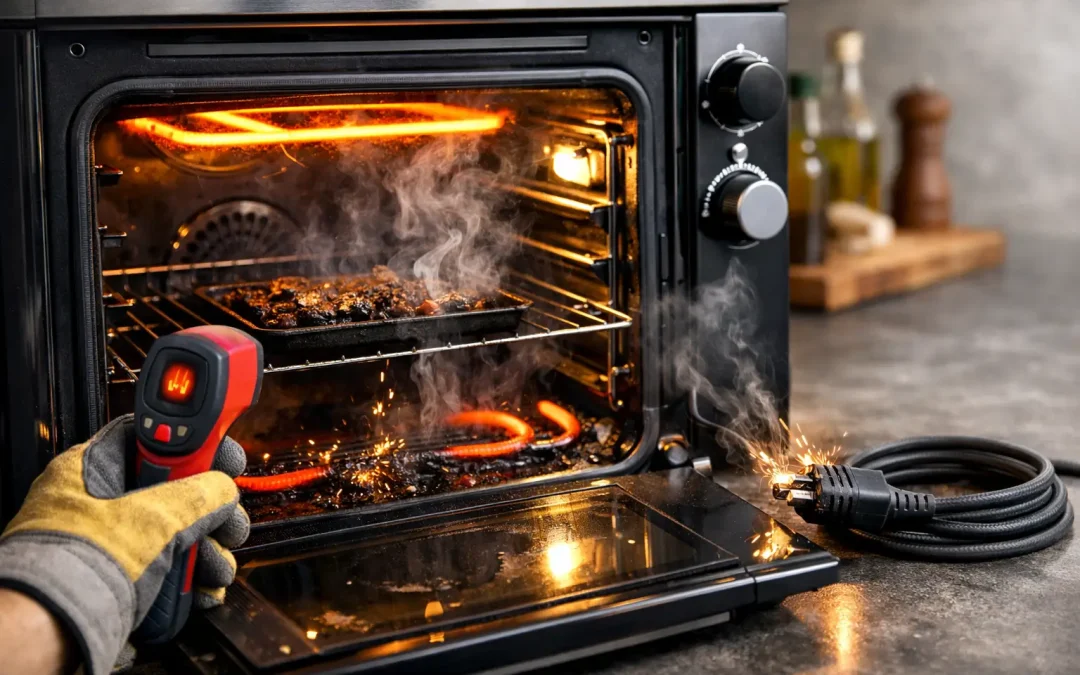
A working element should glow evenly when it is active, although the exact appearance varies by model. If you see blistering, cracks, burnt spots, sparking, or a section that never heats, stop using that oven function. A damaged element can short out, trip the breaker, or cause further damage to the appliance.
It may be tempting to order an element and replace it yourself. However, element failures are not always limited to the element itself. Loose wiring, a damaged connector, or a failing control relay can cause a replacement part to fail again. A qualified technician can inspect the full circuit and make sure the repair addresses the underlying cause.
The control panel, clock, or display does not work
Modern electric ovens depend on electronic controls for temperature settings, timers, cooking modes, and safety functions. A blank display may result from a power interruption, but it can also be caused by a failed electronic control board, damaged wiring, a defective touchpad, or a blown internal fuse.
Try resetting power at the breaker for a few minutes, then restore it. If the display remains blank, flashes error codes, loses settings, or responds only intermittently, service is usually the safest option. Do not remove panels or attempt to bypass a control lock, fuse, or safety switch. Electric ovens use high-voltage circuits even when they appear to be off.
The oven door will not close, lock, or unlock
A door that does not close tightly allows heat to escape, leading to longer cook times and inconsistent results. Check for food debris around the gasket, hinge area, and door frame. Clean gently with a nonabrasive cloth once the oven is cool.
If the door is crooked, springs back open, or has a torn gasket, the hinges or seal may need attention. During a self-clean cycle, some models use a motorized lock. A locked door after the cycle ends may indicate a failed lock assembly, temperature sensor issue, or control problem. Avoid forcing the door open, as this can damage the glass, hinges, or locking mechanism.
The oven smokes or smells unusual
A little smoke from spilled food or residue during the first use after cleaning can be normal. Persistent smoke, a strong burning-plastic smell, visible sparking, or an electrical odor is not normal. Turn the oven off, switch off the breaker if it is safe to do so, and avoid using the appliance until it has been checked.
Smoke can come from grease buildup, but it can also signal burned wiring, a failing element, or an overheated component. The trade-off is simple: cleaning a minor spill is reasonable; continuing to cook through an electrical smell is not worth the risk.
What You Can Check Before Booking Repair
Homeowners can often rule out a few simple causes without opening the appliance. Confirm the clock is set if your model requires it, check that the control lock is off, inspect the door gasket for obvious damage, and reset a tripped breaker once. You can also remove loose food debris after the oven has cooled completely.
Do not test live wiring, disassemble the rear panel, use a damaged cord, or keep resetting a breaker that trips. An electric range or wall oven operates on a higher-voltage circuit than many household appliances. The right repair is not just about getting heat back – it is about restoring safe operation.
When a Professional Repair Makes Sense
Call for service when the oven has no heat, repeatedly trips the breaker, shows an error code, produces an electrical smell, has a cracked element, or cooks far outside the selected temperature. These symptoms can overlap, and replacing the wrong part can cost more than a proper diagnosis.
For busy households, a clear on-site assessment saves time. A technician can test the elements, sensor, wiring, power supply, door components, and electronic controls, then explain what failed and what the repair involves. Insta Fix Repairs provides straightforward estimates, same-day service when available, and a 90-day warranty on parts and labor for homeowners who need dependable electric appliance support.
If your oven is unreliable, avoid planning another meal around guesswork. A prompt diagnosis can help you get back to cooking with confidence and prevent a small electrical issue from becoming a larger interruption.