
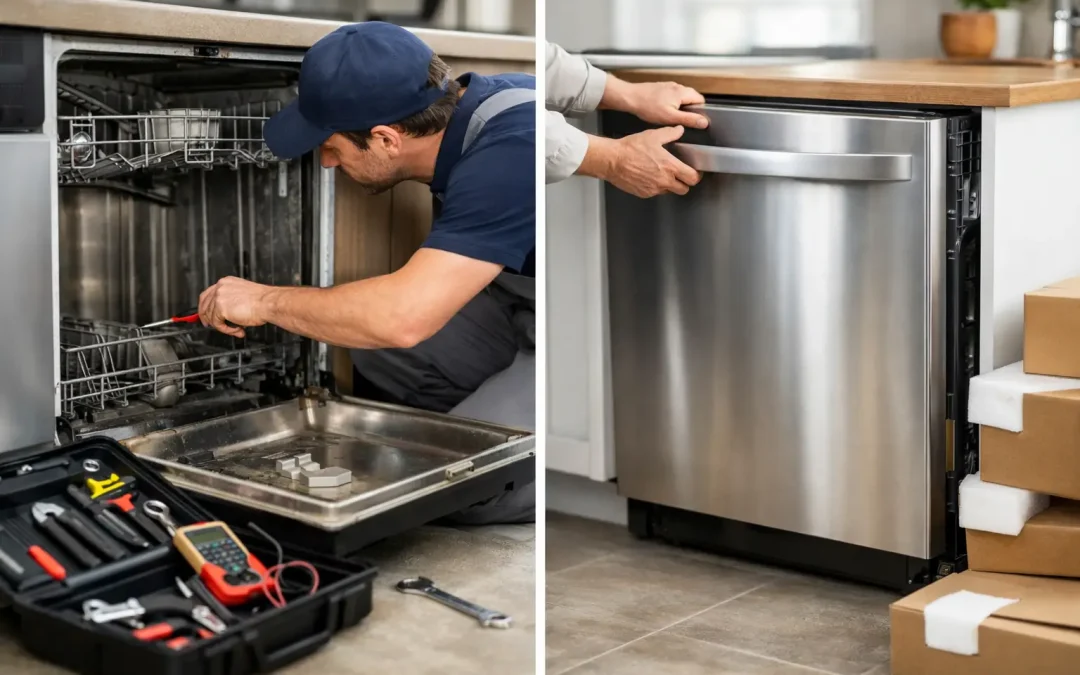
A dishwasher that stops draining the night before guests arrive creates a frustrating question: dishwasher repair vs new dishwasher – which option actually makes financial sense? The right answer is not always “replace it” or “fix it.” It depends on the appliance’s age, the failed part, its overall condition, and whether a reliable repair can restore it for years rather than weeks.
For most homeowners, the best first step is a professional on-site diagnosis. A clear estimate gives you the facts before you spend money on a new appliance, arrange installation, or live without a working dishwasher longer than necessary.
Dishwasher Repair vs New Dishwasher: Start With the Age
Age matters because every dishwasher has a practical service life. A well-maintained model often lasts about 10 to 12 years, although some units last longer. If your dishwasher is five years old and has a single failed component, repair is usually the sensible choice. If it is 13 years old, has several recurring issues, and needs an expensive major part, replacement may offer better value.
That said, age should not be the only deciding factor. A newer dishwasher can still have a costly control board failure, while an older, dependable model may only need a door latch, inlet valve, or drain pump. The goal is to understand whether you are solving one isolated problem or paying for the first of several likely repairs.
A technician should also look beyond the immediate symptom. For example, a dishwasher that will not start could have a simple latch issue, a wiring problem, or an electronic control failure. Those repairs have very different costs and long-term outlooks.
When Dishwasher Repair Is Usually Worth It
Repair is often the better choice when the dishwasher is under eight years old, has been reliable until now, and the issue is limited to one serviceable part. Common problems that are frequently worth repairing include poor draining, leaking from a worn gasket, a faulty door latch, a broken detergent dispenser, a failed water inlet valve, or a damaged spray arm.
These issues can interrupt daily routines, but they do not automatically mean the entire appliance has reached the end of its life. Replacing the affected component can return normal washing performance without the larger expense of purchasing and installing a new unit.
Repair can also make sense for a higher-quality dishwasher. If the racks are in good condition, the tub is intact, the door closes properly, and the machine has cleaned well before the recent failure, a targeted repair may preserve an appliance you already know works for your household.
There is a convenience factor, too. Buying a new dishwasher is not just the price on the showroom tag. You may need to wait for delivery, confirm cabinet measurements, remove the old appliance, arrange installation, and potentially address plumbing or electrical connections. A same-day or prompt repair can be the faster path back to clean dishes.
A Simple Cost Guideline
Many homeowners use the 50 percent rule as a starting point: if a repair costs less than roughly half the price of a comparable replacement dishwasher, repair is often worth considering. It is a helpful guideline, not a hard rule.
A $300 repair on a six-year-old dishwasher may be a smart investment. The same $300 repair on a 14-year-old machine with rusty racks, weak cleaning, and a history of leaks may only delay replacement. A technician’s diagnosis helps put the estimate in context instead of treating every repair quote the same way.
Signs a New Dishwasher May Be the Better Investment
Replacement becomes more appealing when the dishwasher has multiple symptoms, expensive internal failures, or clear signs of deterioration. A cracked tub, repeated motor problems, major corrosion, or a leaking unit that has already caused cabinet or floor damage deserves careful consideration.
Frequent repairs are another warning sign. One repair every few years is normal for many appliances. Several service calls in a short period can mean that other aging components are beginning to fail. In that case, putting more money into the existing machine may not provide the dependable result your household needs.
You may also choose a new dishwasher for improved performance. Older models can be louder, less efficient, and less effective at drying plastics or removing baked-on food. A modern replacement may offer quieter operation, adjustable racks, better water management, and wash cycles that better match your family’s routine.
Still, energy savings alone rarely justify replacing a dishwasher that only needs a modest repair. Utility savings build gradually. If your current appliance is relatively young and repairable, the immediate savings of fixing it may outweigh the benefits of a newer model.
Major Failures That Change the Calculation
Some repairs are naturally more expensive because they involve central components. A failed circulation motor, damaged sump assembly, significant electronic control issue, or serious internal leak can shift the decision toward replacement, especially on an older dishwasher.
Part availability matters as well. If a manufacturer has discontinued a key part, or if the part carries a high cost with no guarantee that other aging components will hold up, a new dishwasher may provide more certainty. A qualified technician can explain whether the repair is a practical long-term solution or a temporary gamble.
Do Not Ignore Installation Costs and Compatibility
A new dishwasher price is only part of the replacement budget. Installation, hauling away the old unit, new supply lines, a power cord, connection fittings, or cabinet adjustments may add to the final cost. Homes with older wiring or plumbing arrangements can require additional work to bring the installation up to current requirements.
Before choosing a replacement, measure the opening carefully and check the dishwasher’s height, width, depth, and door clearance. A model that looks like a standard fit can still create problems if flooring was installed after the old dishwasher, cabinetry has shifted, or a nearby drawer blocks the door.
If you do replace the appliance, professional installation helps protect your investment. An incorrectly connected drain hose or water line can cause leaks, poor draining, or water damage that costs far more than the installation itself.
Ask These Questions Before You Decide
A good repair visit should leave you with more than a price. Ask how old the dishwasher is likely to be, what caused the failure, whether other components show wear, and what the expected life may be after repair. You should also ask whether the proposed part is covered by a warranty and whether labor is guaranteed.
Clear answers matter. A trustworthy technician will not pressure you into a repair that does not make sense, and will not tell you to replace a dishwasher that can be dependably restored at a fair cost. The best recommendation is based on your appliance, not a one-size-fits-all rule.
Protect the Dishwasher You Have
Whether you repair or replace, a few habits can prevent avoidable problems. Clean the filter regularly, remove food scraps before loading, and check the spray arms for blocked holes. Use dishwasher detergent intended for automatic machines, and avoid overloading racks so water can circulate properly.
Pay attention to early warnings. Water left in the bottom of the tub, a door that needs to be pushed closed, grinding sounds, weak cleaning, or moisture under the machine are all reasons to schedule service before a small issue becomes a major failure. If you notice an active leak, stop using the dishwasher until it has been inspected.
For homeowners who need a quick, straightforward answer, Insta Fix Repairs can diagnose the problem on-site, explain the repair options clearly, and provide a transparent estimate. With same-day service when available and a 90-day warranty on parts and labor, you can make the decision with confidence instead of guessing.
A dishwasher should make your home run more smoothly, not leave you weighing surprise costs after every cycle. Get the real cause identified first, then choose the option that gives your household the most reliable value for the years ahead.